
When documentation eats security: the regulatory tangle Norwegian businesses face
GDPR, NIS2, DORA, CRA, the Security Act, and at least three authorities to notify for the same incident. A recent op-ed on digi.no puts into words what many SMBs feel: digital security regulation has become a burden competing with security itself. We look at the tangle, and at three steps you can take without waiting for Brussels.
 Håkon BerntsenChief Technology Officer
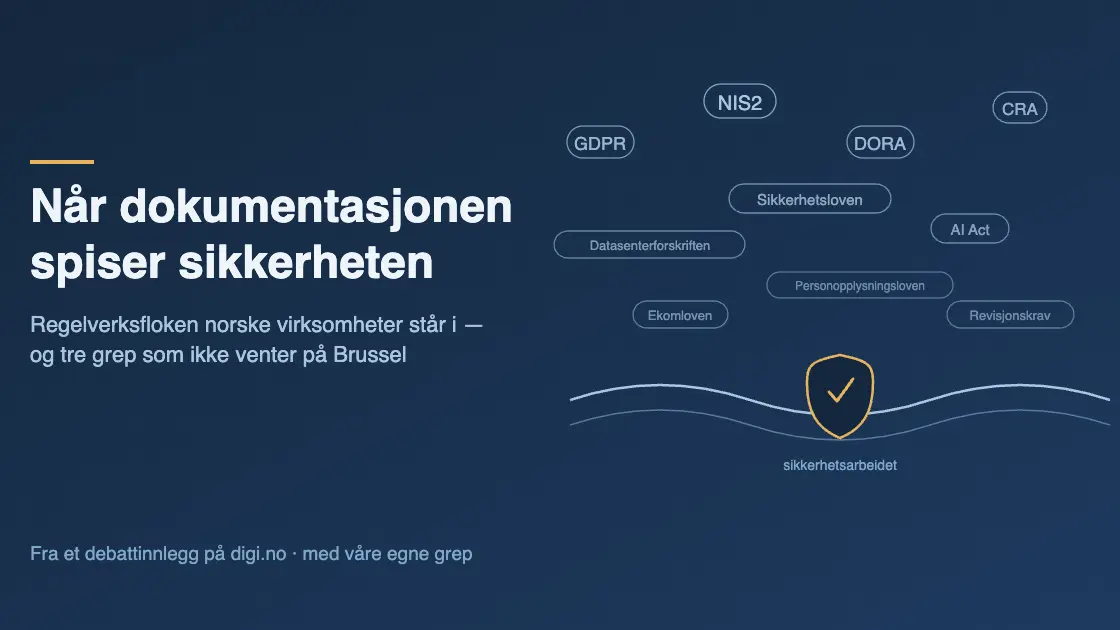
An op-ed on digi.no this week puts precise words on something many in Norwegian businesses feel first-hand. Attorney Marit Stubø Jorde of the law firm Alver describes a European regime for digital security that no longer consists of one or two sets of rules, but dozens, and argues that the sum is becoming a problem in its own right. Not because the regulation is illegitimate, but because it is uncoordinated.
The piece deserves to be read in full. Here is the core of the argument, and three practical steps we believe businesses can take in the meantime.
The tangle: one incident, many obligations
Jorde's examples are concrete. A single security breach can trigger notification duties to several supervisory authorities at once: the Data Protection Authority, Nkom and the National Security Authority, plus any sector-specific regulators. One business can be required to perform risk assessments under several frameworks in parallel, such as GDPR, NIS2, DORA, CRA, the data centre regulation or the Security Act. They have partly different methodological requirements and reporting formats for what is in practice the same assessment.
The result is what the piece calls legal-technical ambiguity and double regulation: overlapping provisions that create genuine doubts of interpretation, where the business must choose between producing parallel documentation in watertight compartments, or undertaking a demanding harmonization exercise on its own to avoid contradictory routines.
Who pays: those without a compliance department
The piece's most important observation is the distributional effect. Large enterprises can build compliance apparatuses and absorb the burden. Small and medium-sized businesses make up the majority of the European technology economy. According to the piece, they spend a disproportionate share of their capacity on documentation rather than actual security measures. Let that sink in: the regulation meant to produce more security can, for the smallest, crowd out the security work itself.
The piece also points to the competitive effect: American and Asian hyperscalers operate without equivalent burdens in their home markets. The bill for European regulatory complexity is thus partly paid in lost capacity for innovation and scaling. As Jorde sums it up, businesses carry a regulatory burden that is as much a budgeting problem as a security problem.
Hoping for harmonization is allowed. It is not a plan.
The piece's proposed solutions are aimed at legislators: simplification, systematic harmonization, and sector directives that explicitly clarify their relationship to other directives. That is sensible, and outside any single business's control. In the meantime, there are steps that are within it. Three of them we know well from experience.
Harmonize internally, even if the regulations don't. No provision requires you to write five separate risk assessments from scratch. Build one internal control framework with one methodology, and map the various regulatory requirements into it. Each new directive then becomes a column in the mapping, not a new parallel universe. The harmonization exercise Jorde describes is demanding, but it is done once. The watertight-compartments alternative is paid for every year.
Make documentation a by-product of operations. The distinction between "implementing measures" and "documenting measures" is largely a systems choice. Businesses where access, changes, exercises and deviations are logged continuously in the systems people already work in can generate much of their audit material automatically, instead of reconstructing it in a scramble before every reporting deadline. Every hour of documentation moved from human to machinery is an hour returned to actual security work.
Measure security and compliance separately. The most dangerous side effect of documentation pressure is that the paperwork becomes the goal. Keep two separate ledgers: one for compliance (deadlines, notifications, documents) and one for actual security (exercises held, recovery times tested, vulnerabilities closed). When the two are confused, you end up with perfectly documented businesses that cannot withstand an incident, the worst of all combinations.
Conclusion
Jorde is right that the tangle must be resolved where it was created: with legislators, through harmonization. But Norwegian businesses cannot put their security work on hold until Brussels and Oslo have tidied up. The practical line in the meantime is to build one internal truth: one framework, continuous evidence production, and a clear separation between paper and protection. The regulations will keep overlapping for a while yet. That doesn't mean your work has to.
Based on the op-ed "Europeiske virksomheter drukner i sikkerhetskrav" by Marit Stubø Jorde, law firm Alver, published on digi.no on 16 July 2026. Our account is paraphrased. Read the piece in full at digi.no. The three steps and the assessments in the final section are our own.