
When AI becomes geopolitics: open models under pressure, a cloud price war, and why efficiency wins
Restrictions on open AI are being discussed in Washington, Chinese open models are pressuring Western giants, and OpenAI and Anthropic are subsidizing tokens in a price war neither can afford to lose. We've distilled an insightful episode of The AI Daily Brief, and added what matters for Norwegian businesses.
 Jon Gottfred AndersenChair of the Board and dermatologist
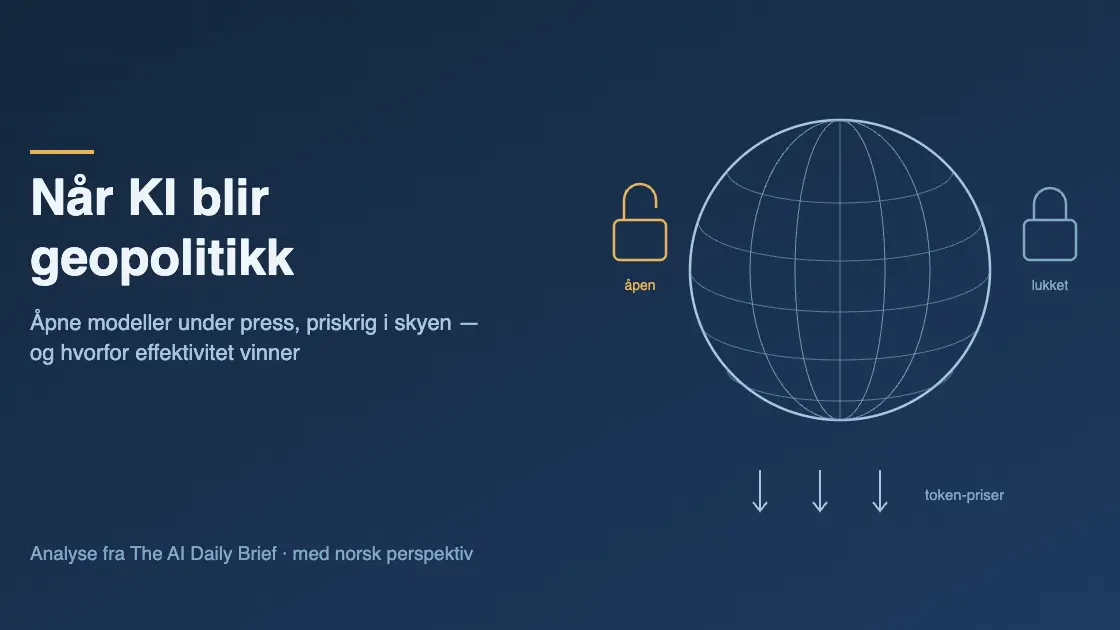
Three news items from the same week: Washington is discussing restrictions on open AI for security reasons. A Chinese open model family is pressuring Western giants on price and efficiency. And two of the world's largest AI companies are selling tokens at a loss to win market share. Individually, they're industry news. Together, they say that AI has stopped being a purely technological question: it has become trade policy, security policy and a price war all at once.
A recent episode of The AI Daily Brief pulls these threads together in a way that's worth retelling, and worth thinking further about from a Norwegian vantage point.
About the source
The AI Daily Brief is a daily American podcast on AI news and analysis, hosted by Nathaniel Whittemore. It is among the most followed industry podcasts, particularly among people working hands-on with AI, and is good at connecting individual news items to the larger currents. What follows is our account of the episode's analysis, paraphrased rather than quoted, with our own assessments clearly separated toward the end.
Open AI has become security policy
The episode's most thought-provoking thread is that openness itself is becoming a geopolitical battleground. In the US, according to the episode, there is discussion of whether the Trump administration may impose restrictions on open AI for national security reasons, the logic being that freely available model weights are also freely available to adversaries.
At the same time, pressure comes from the opposite direction: Chinese players are challenging Western dominance precisely through open, highly efficient models. The episode highlights the GLM family. That inverts the familiar narrative. Open source was long the West's showcase. Now it is increasingly Chinese labs using openness as a strategic weapon, while American frontier labs close up and American politicians consider closing the rest.
For anyone building on open models, like us, this is worth watching closely. Access to open weights has been treated as a given. It is one political decision away from not being one.
The price war: subsidized tokens are not a price list
The second thread is commercial: OpenAI and Anthropic are, according to the episode, in an intense price war in which tokens are effectively subsidized to win volume and lock-in. To customers it looks like AI is getting cheaper. That is partly true, and partly an illusion.
Subsidized prices are not a price list. They are an investment in your dependency. The story from cloud economics is well known: first cheap, then indispensable, then priced accordingly. Anyone building their cost model on today's token prices from two companies losing money on every call has built on an assumption that someone else controls. The episode's third news thread, allegations of IP theft between Apple and OpenAI, reinforces the same picture: the industry is hardening, and the big players are acting accordingly.
The real shift: from raw power to system efficiency
Beneath both the geopolitics and the price war lies the episode's most interesting observation: competition is moving from who has the biggest model to who has the most efficient system. Token efficiency, smart routing between models, agent orchestration and inference costs are coming to matter more than raw parameter power. That is how the Chinese open models are challenging, not by being biggest, but by delivering the most per krone.
We recognize this. When we recently tested five local models on our own tasks, the recurring finding was precisely that the right model for the right job beats raw size, and that measured throughput on your own hardware, not parameter counts, is the only cost metric that holds. What was an operational lesson for us is becoming the industry's main rule.
What this means for Norwegian businesses
The episode is American and concerns American and Chinese actors. But the consequences land here too, and three of them are concrete enough to act on.
Map your AI dependency now. Which processes stop if the API price doubles, the context window is restricted, or the provider changes terms? This is the same exercise as any other continuity planning: a dependency you have mapped and accepted is a decision. A dependency you have no overview of is a vulnerability.
Treat open models as a real option, while they are one. Open weights you have downloaded, nobody can revoke. A business that has tested and documented that its core tasks can be handled by open models on its own or rented hardware has a negotiating position and an exit. One that hasn't, has a vendor.
Calculate cost as measured efficiency, not list price. Subsidized token prices and benchmarks are both unreliable bases for decisions. What holds is measuring your own tasks, in your own language, against real operating costs, whether the models run in the cloud or on a box in the server room.
Conclusion
The big picture from the episode is not that open AI is losing or that prices are falling. It is that the ground assumptions, such as access, price and openness, have become moving parts in a geopolitical and commercial game in which none of the players has Norwegian businesses' interests as a goal. The answer to that is not panic, but the same boring, effective answer as elsewhere in preparedness: map the dependencies, secure real alternatives, and measure what actually matters. Those who do can regard both price wars and export policy as weather, unpleasant at times, but not existential.
Based on an episode of The AI Daily Brief (June 2026). Our account of the episode's analysis is paraphrased. Listen to the episode for the details and full reasoning. The assessments in the final two sections are our own.