
950 agents, 21 hours and a new discovery in biology
Claude agents independently found an unknown enzyme system with CRISPR-like features. What the discovery tells us about how knowledge work will look, in Norway too.
 Jon Gottfred AndersenChair of the Board and dermatologist
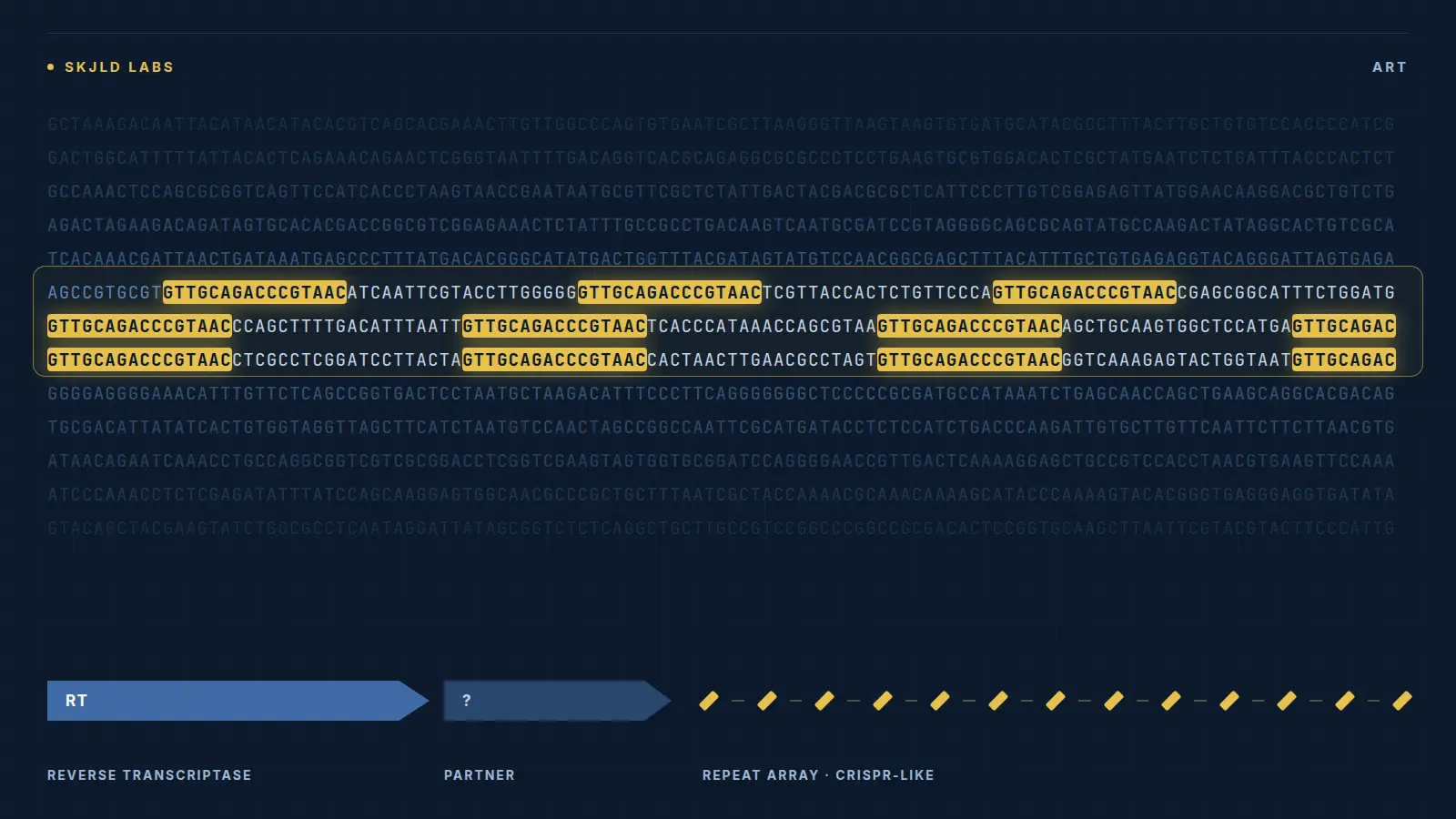
Conceptual illustration by Skjld Labs: a synthetic DNA sequence with an evenly spaced array of repeats, as ART is described. The sequence is invented and does not show the actual system.
Today Anthropic published something that deserves more attention than the usual stream of AI news. The company's new life sciences research group let Claude search through enormous amounts of DNA data, and Claude found a previously unknown enzyme system in bacteriophages. The system has features reminiscent of CRISPR, the technology that revolutionised gene editing. Anthropic's announcement.
What matters here is not that an AI "helped" researchers. What matters is how the discovery was made.
What actually happened?
The researchers gave Claude a high-level task: find interesting new examples of reverse transcriptase (RT), a type of enzyme that copies RNA into DNA. Then the humans stepped back. Roughly 950 Claude agents worked in parallel for 21 hours, using 210 million tokens. They gathered over 200,000 enzymes, picked out 3,500 new candidate systems and narrowed that down to the 20 most promising. For each of these, the agents wrote a report humans could read.

One agent noticed something in raw DNA sequence: a regular pattern of repeating sequences right next to an unusual enzyme. The agent counted the repeats, measured their spacing, compared them with known systems, searched the literature for earlier descriptions and concluded that this was new. Then it filed a report for human review.
The enzyme itself was already known. But nobody had noticed what made the system special: an array of repeating DNA sequences and an accompanying protein of unknown function. Anthropic calls the system ART. The first lab experiments show that the array is expressed as short, distinct RNA molecules, suggesting the system may be programmable, as CRISPR is. What ART actually does is not yet known, and Anthropic is open about that.
Feng Zhang of MIT and the Broad Institute, one of the pioneers of CRISPR gene editing, has read the preprint. He describes the finding as genuinely intriguing and worth further investigation.
Why this is a turning point
For an experienced researcher, this kind of analysis takes weeks to months. Here it took a day. But speed is not the most interesting part. The most interesting part is the division of labour.
Humans set the direction and did the lab work. The agents did the searching, the assessment and the first critical filtering. Claude read the literature, reproduced known results to check its own methods, proposed hypotheses and eliminated most of them itself before anything reached a human.

Anthropic also describes something we think is underrated: when AI produces hypotheses by the thousand, the hypotheses themselves become an object of study. The researchers analyse which proposals they choose to test and which they set aside, and feed that back into the instructions. The agents are learning the researchers' scientific judgement.
This is not AI replacing the expert. It is AI making the expert's judgement scalable.
This is not just for biologists
The pattern is general: many agents searching broadly through large datasets, noticing anomalies, assessing the evidence critically and delivering readable reports to a human who makes the decision.
Think of an accounting firm with thousands of receipts, a law firm with decades of case files, or a clinic with patient records. In all of these businesses there are patterns nobody has had time to look for. The unusual receipt. The clause that keeps appearing in contracts that ended in disputes. The combination of symptoms that shows up more often than it should. These are the same qualities that found ART: patience, breadth and the ability to say "this is odd".
The great leaps in biology have historically begun with someone noticing something strange. Restriction enzymes, PCR and CRISPR all started that way. Now that first moment of attention can be automated.
But where does the data live?
This is the question we at Skjld Labs believe Norwegian businesses must ask now, before agents become everyday tools rather than after: when hundreds of agents are going to read through everything you have, where does that happen?
Anthropic worked with public DNA databases. Norwegian knowledge businesses work with client data, patient data and trade secrets. For them the question is not only whether AI can find the patterns, but whether the data can leave the building for it to do so.
We believe the answer for many will be a hybrid: local infrastructure where the sensitive data lives and where the broad, repetitive review happens, combined with the most advanced models where the task requires it and the data allows it. The point is that you decide where the line goes, not the vendor.
What to take away
Anthropic shared the finding early, before they know what ART does, because they believe the most important message is the method. We agree. What happened today is a demonstration that AI agents can drive independent inquiry from raw data to a reasoned hypothesis, with humans as judges rather than as labourers.
The question for Norwegian businesses is no longer whether this will reach their own field. It is who owns the infrastructure when it does.
Considering how AI agents could work through your own data without it leaving the building? Book a no-obligation call, or read more about the AI systems and agents we build.
Sources: Anthropic: Claude discovers a novel enzyme system with CRISPR-like repeats (23 September 2026) and the technical report (preprint). Graphics: Skjld Labs.