
Half the web is robots: how Norwegian businesses should think about their website
More than half of all web traffic is now machines, and more customers find businesses via AI answers. How Norwegian companies should think about their website now.
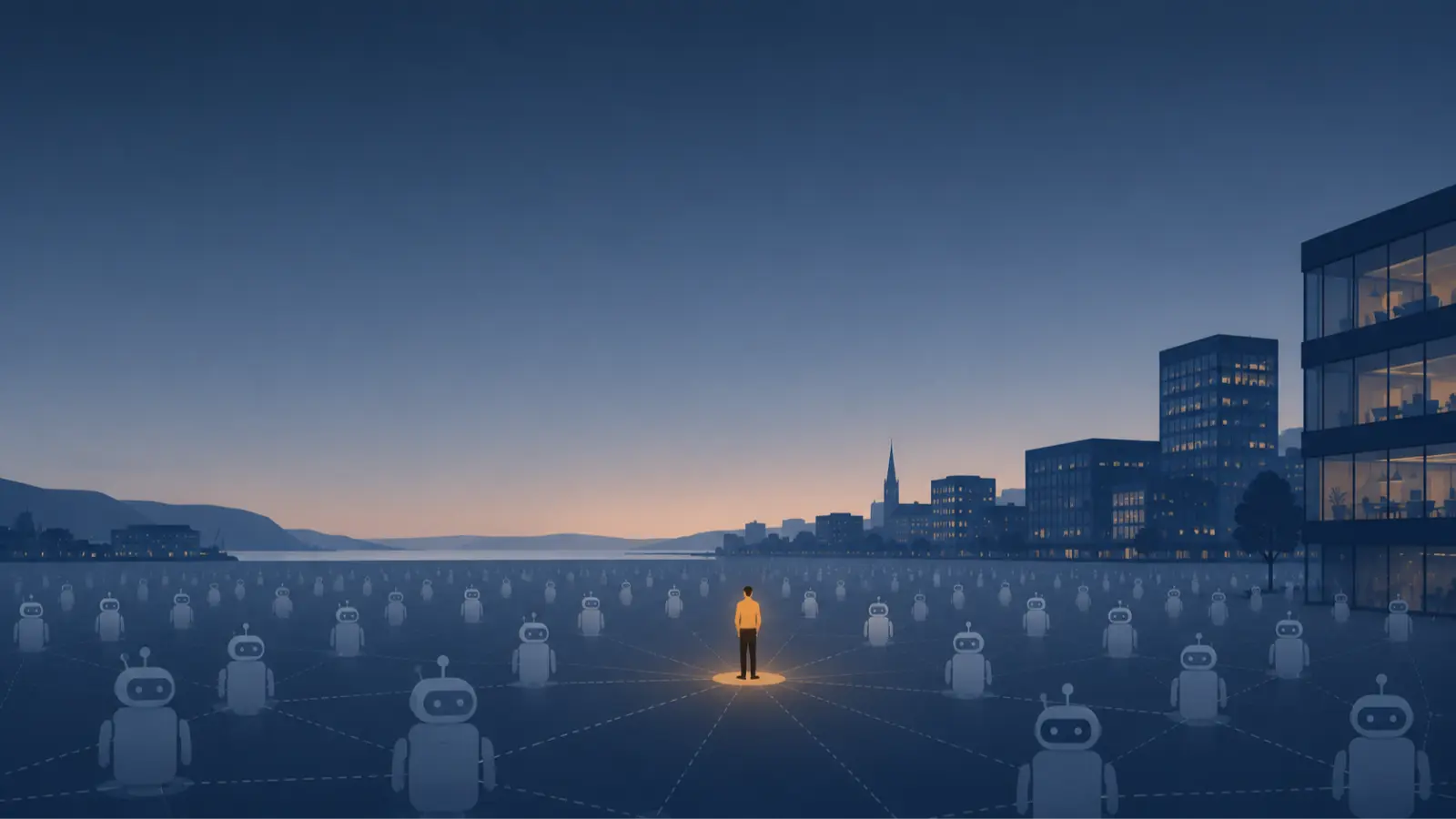
The web is becoming a place where machines talk to machines. Recent measurements suggest that more than half of all internet traffic is now automated: bots and AI agents, not people. At the same time, a growing number of customers reach businesses through AI answers rather than an ordinary Google search. For Norwegian companies, this means your website has to serve two audiences: the people you want to reach, and the machines that read and relay your content.
Machines read the web, at scale
In Thales' 2026 Bad Bot Report, automated traffic made up 53 percent of all activity on the web in 2025. So-called bad bots are traffic that scans for vulnerabilities, tests passwords or harvests content. They accounted for 40 percent on their own, while only around 7 percent was genuine human traffic. AI-driven bot activity increased more than twelvefold over the year.
Cloudflare reached a similar picture when the figures were covered in the Norwegian press: bots and AI agents at 57 percent of traffic, humans at 43. But it pays to stay level-headed here. Another measurement firm, BrightEdge, registered only 15 percent bot traffic, and professor Olav Lysne reminded readers of kode24 that a company that "lives off solving internet capacity problems" has a vested interest in painting the picture dramatically. The exact share is disputed. The direction is not: an ever-larger part of what hits your website is not a human.
Machines also answer for the web
The other side of the shift is how people find you. Use of generative AI services is growing fast: figures from Similarweb show that monthly visits to AI platforms rose 70 percent in a single year, to 9.5 billion. Many people now put their question to ChatGPT, Gemini or Perplexity and get a finished answer, without clicking through to a website.
That means ranking high on Google is no longer enough. You also have to be cited by the AI that answers. For now, citation is rare but rising: ChatGPT gave sources in roughly 1.6 percent of answers in June 2025, and 6.8 percent a year later. It varies sharply between industries. Becoming one of the sources the AI draws on is turning into a discipline of its own, often called GEO, generative engine optimization.
Two audiences on one website
The consequence is a balancing act. You want to keep malicious bots out, while still letting in the legitimate AI crawlers that can make your business visible in AI answers. That is not trivial: Thales found that more than 10 percent of sessions from legitimate AI services triggered the same defensive rules as malicious traffic. Block too hard, and you become invisible to the tools your customers actually use. Block too little, and you pay for traffic and attack surface you don't want.
It also changes what is worth measuring. Visitor counts alone say less and less when a large share is machines, and when a person can get the answer about your business without visiting the page. What counts is the real outcomes: enquiries, meetings, sales.
What Norwegian businesses should do now
This calls for no panic, but a few deliberate moves:
- Write for both people and machines. Clear structure, precise headings, concrete facts and source references make content both better for readers and easier for an AI to cite.
- Separate legitimate crawlers from malicious bots. Use bot management that lets in the AI services you want to be found by and shuts out the rest, rather than turning everything off.
- Measure outcomes, not traffic. Track enquiries and sales, not just visitor numbers that are increasingly inflated by automated traffic.
- Keep control of your own data. Decide for yourself what should be open for AI to read and what should not. That is a strategic choice, not a technical detail.
The web does not become less important because machines take over more of it, but the rules of the game are changing. The businesses that understand that a website now speaks to both people and robots are the ones that will still be found when a customer asks an AI.