
From autonomous agents to systems that know the craft: five trends in AI engineering
"Set the agent loose and hope for the best" is already an outdated strategy. The industry is moving toward structured systems: skills as the building block, humans as the control point, and data security as a first-class requirement. We’ve distilled a recent episode of The AI Daily Brief, and added what we’ve learned ourselves.
 Johannes Ryvænge GjesetFull-stack developer
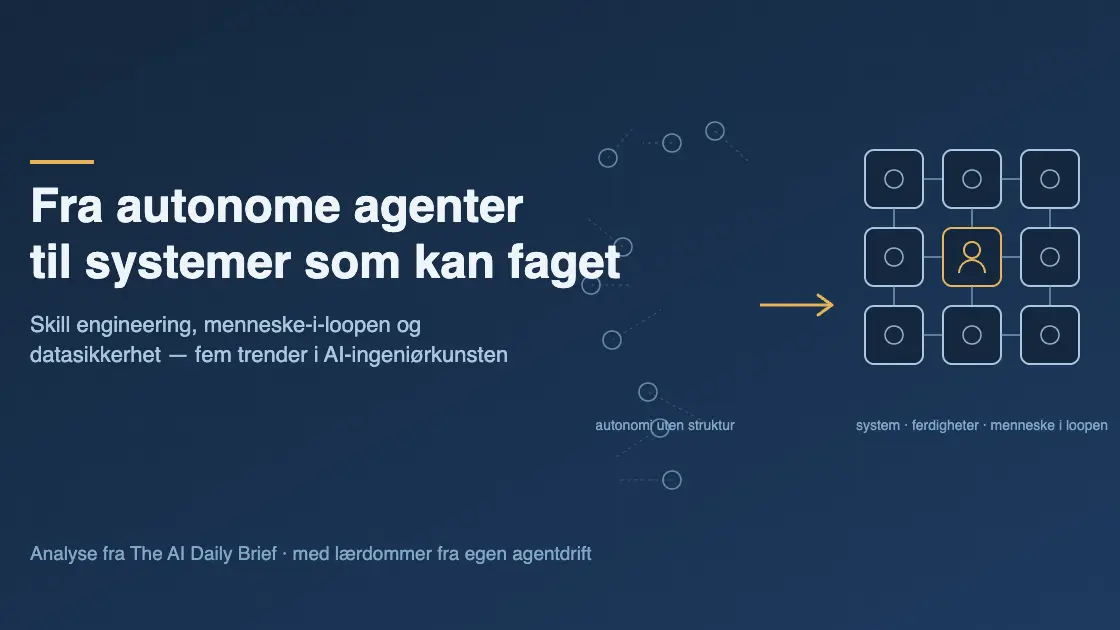
A year ago, "autonomous agent" was the most promising phrase in AI: give the model a goal, tools and free rein, and watch the work do itself. Everyone who actually tried it in production discovered the same thing: autonomy without structure produces sloppiness at scale. Now the industry is turning, not away from agents, but away from unstructured agents.
A recent episode of The AI Daily Brief, the daily American industry podcast we've highlighted before, collects the shift into five trends. They're worth knowing, because they describe quite precisely where agent-building is heading: from magic to engineering.
Trend 1: From autonomy to system
The underlying movement is from standalone, free-roaming agents to systemic frameworks: structured pipelines where agents have defined roles, defined handovers and defined boundaries. The episode uses terms like "software factory": not one brilliant do-everything agent, but an assembly line of specialized steps with control points in between. It's less glamorous than the autonomy vision. It's also what actually works.
Trend 2: Skill engineering makes skills the building block
The most practical idea in the episode has a name: skill engineering. Instead of hoping the model "understands" the task from a long prompt, domain knowledge is packaged as reusable skills: documented procedures, templates and tools the agent loads when the task requires it. The knowledge moves out of the prompt-writer's head and into an artifact the team owns, versions and improves.
We recognize this from our own operations: the difference between an agent that "feels its way" and one that follows a tested procedure is the difference between an intern and a skilled tradesperson. The skills, not the model choice, are often where quality is decided.
Trend 3: Human-in-the-loop is a design principle, not a band-aid
The episode is clear that human oversight is no longer treated as a temporary crutch while waiting for better models, but as a permanent design principle: defined points where a human approves, corrects or stops. The distinction runs between the agent's "inner loop" (the work it does itself) and the "outer loop" (where humans set direction and assure quality).
Our experience is the same, and we've phrased it before: the agent writes, the human publishes. That's not distrust of the technology. It's the same division of labour as between a capable employee and a responsible editor.
Trend 4: Data security moves up the queue
The episode highlights the discussion around inadvertent uploading of sensitive source code to AI services, brought to a head by incidents at major players, and a broader unease: agents with tool access handle the business's actual data, not just text drafts. "Zero data retention" and explicit data boundaries are becoming procurement requirements, not footnotes.
For Norwegian businesses this is familiar territory with a new twist: the question "where is our data?" must now be asked per agent and per tool, not just per cloud provider. The more agents are allowed to do, the more deliberately their boundaries need to be set.
Trend 5: AI moves into physical interfaces
The lightest trend in the episode: AI companies are experimenting with their own hardware, from smart speakers to dedicated controllers for coding agents. Reception is mixed, and it's too early to say what sticks. But the direction is interesting: as agents become work tools, some of them will get buttons.
What this means in practice
The sum of the trends is a maturation shift. The question "which model is smartest?" is being replaced by three duller and more important ones: What structure do your agents work in? Where do their skills live, and who maintains them? And where are the humans in the loop?
That's good news for most businesses. Structures, procedures and control points are things organizations already know how to do. It isn't research competence. It's work management. Those who treat agents as new employees with training needs and clear boundaries will get further than those waiting for the model that needs neither.
Based on an episode of The AI Daily Brief (June 2026). Our account is paraphrased. Listen to the episode for the details. The assessments in the final two sections and the practical parallels are our own.